Key Takeaways
Pull-in vs. back-in lifts is primarily a preference decision—but must be chosen before installation.
Using a lift incorrectly can cause serious damage to your boat and system.
Back-in lifts are better for rear-entry boats but require additional cost and setup.
Choosing the right configuration improves usability, safety, and long-term satisfaction.
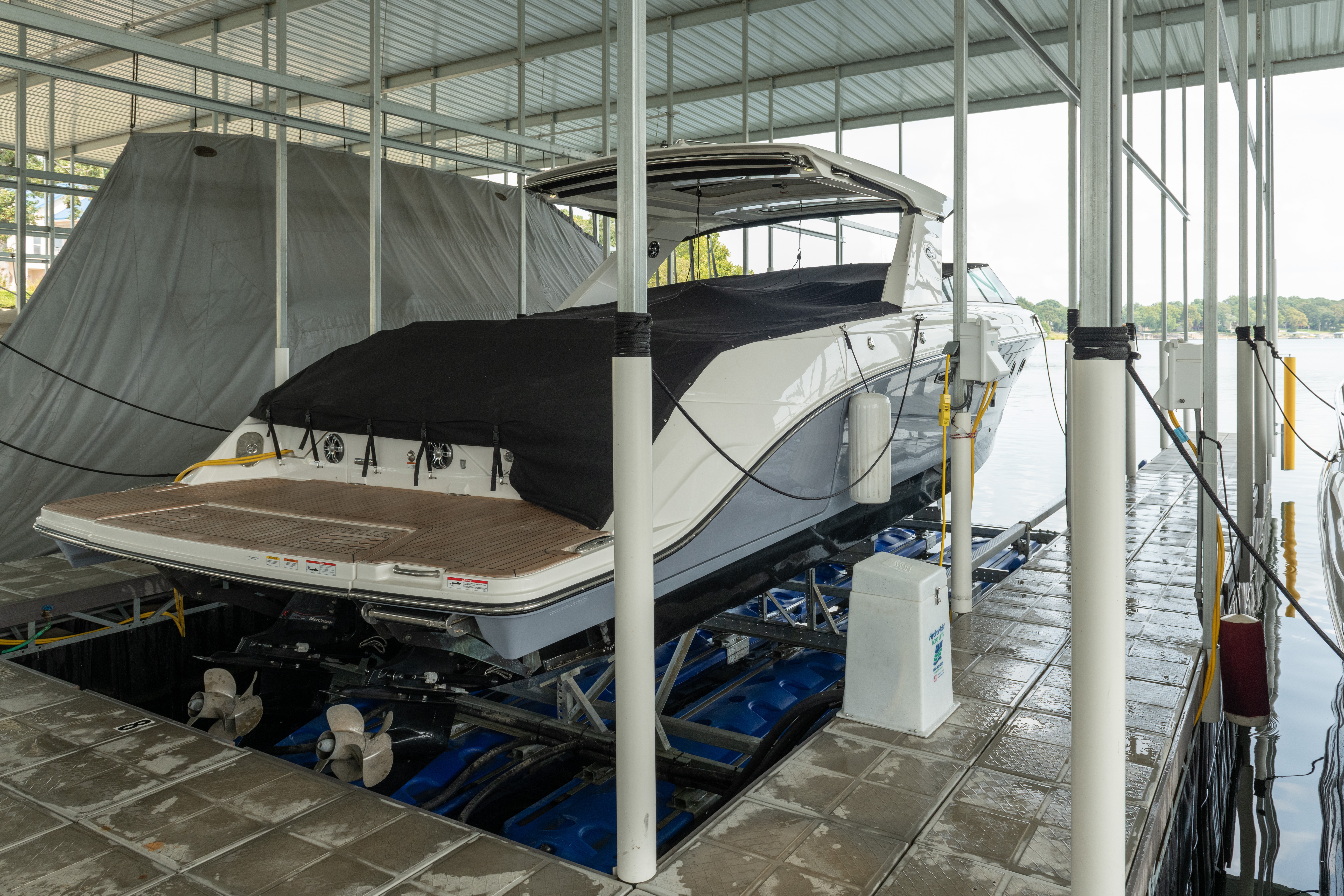
What Is the Difference Between Pull-In and Back-In Lifts?
The main difference between a pull-in and back-in boat lift comes down to how the boat enters the slip and where the stern (rear) of the boat sits once lifted. With a pull-in lift, the boat drives onto the lift bow-first, which places the transom and engine weight toward the dock or shoreline side. With a back-in boat lift, the boat is reversed into the slip so the bow faces outward toward open water (BoaterExam, n.d.).
For most boat lifts, a pull-in (bow-first) configuration is standard. Because the engine sits at the open end of the lift, you run zero risk of dragging your prop, rudder, or drive shaft across the underwater crossbeams of the lift structure. They also tend to work well for a wide range of vessels, including pontoons, fishing boats, runabouts, and many wake boats.
Back-in configurations are more specialized and are typically chosen when dock layout, shoreline limitations, or vessel-specific needs make a traditional pull-in layout less practical.
Why This Decision Must Be Made Before Installation
Choosing between a pull-in vs back-in boat lift isn’t simply a matter of docking preference. The decision affects the entire lift configuration, including bunk positioning, structural support placement, guide systems, and weight distribution. Because of this, the preferred configuration must be determined before purchasing the lift.
Most boat lifts are engineered around a bow-in approach because the heaviest part of the vessel (typically the engine and fuel system) remains positioned closer to the primary support structures at the rear of the lift. This standard orientation simplifies weight balancing and allows manufacturers to use proven bunk and beam layouts that work efficiently across many boat types.
Reversing that orientation with a back-in setup often requires additional customization to safely redistribute weight and maintain proper lift performance. It can also influence dock clearance, walkway access, turning radius, and access to dockside utilities.
In many cases, changing from one configuration to another after installation involves significant structural modifications and additional expense, making early planning especially important.
When a Back-In Lift Makes More Sense
While pull-in setups are the default choice for most waterfronts, specific slip dimensions and dock layouts make a back-in configuration highly advantageous. For instance, if your dock leaves your boat exposed to tight fairway maneuvering or heavy traffic, backing in offers superior protection and accessibility.
Other reasons boaters may opt for a back-in configuration include:
Utility Connections: On many larger cruisers and yachts, the shore power inlets, fresh water connections, battery switches, and service access points are located near the transom (rear). A back-in setup places these connections closer to the dock, making routine charging, cleaning, and maintenance more convenient.
Wake Dispersion and Rough Water Protection: The bow is designed to cut through waves and disperse energy. In rougher water conditions or when exposed to heavy traffic, facing the bow toward the water protects the lift structure and the boat from absorbing the flat, heavy impact a wave would make against an exposed transom.
Boarding and Loading Convenience: Backing in places the stern close to the dock, making it easier to load passengers, coolers, and gear. This also avoids the need to climb over the bow or gunwale when finger piers are too short (The Hull Truth, 2017).
Ultimately, the best lift configuration depends on the type of boat, the dock layout, and the environmental conditions at the property. By aligning your lift orientation with the everyday realities of your waterfront, you can better protect your investment and make every launch and return more seamless.
Cost and Setup Differences to Consider
Because most lifts are designed around conventional weight distribution patterns, choosing a back-in boat lift configuration generally entails higher upfront installation costs and more complex engineering requirements than a standard pull-in setup.
Common cost and setup considerations may include:
Bunk and Support Customization: Standard lift bunk brackets are typically designed assuming the heaviest engine weight sits near the rear structural supports. Reversing the boat’s orientation may require upgraded offset brackets, reinforced supports, or longer bunk boards to safely redistribute that load.
Tank Upgrades: Depending on your boat's total weight, a back-in configuration may require larger or repositioned air tanks to ensure the lift rises uniformly without putting undue stress on your dock brackets.
Dock Modifications: Some layouts require additional catwalks, utility routing, or boarding platform modifications to maintain safe access around the vessel. Larger boats may also need significantly more maneuvering space to safely back into the lift, which can affect slip placement and overall dock design.
Additionally, HydroHoist boat lifts typically require a two-valve, two-motor control unit for back-in configurations supporting vessels up to 14,000 lbs. Because high-performance blower motors must push air strategically to balance the heavy stern against the lighter bow, a standard single-valve system won't suffice.
The dual-valve control allows you to independently adjust air distribution to different parts of the lift, ensuring your boat rises safely and perfectly level every time. When totaling these boat lift configuration differences, buyers should anticipate an added financial investment of $800 to $2,500+ above a standard pull-in configuration.
Risks of Using the Wrong Lift Configuration
Using the wrong lift configuration, such as backing a boat onto a lift designed exclusively for a pull-in setup, can place uneven stress on both the boat and the lift. If the vessel’s weight distribution does not align properly with the bunk placement and structural supports, the result can include hull distortion, improper lifting angles, or excessive strain on key lift components.
This wrong lift configuration can also limit maneuvering space and reduce visibility. A lift that is difficult to approach may increase the risk of docking accidents, propeller strikes, or contact with guide posts and dock structures. These challenges are heightened when navigating wind, current, or rough water conditions.
Over time, a poorly matched configuration can accelerate wear on bunks, cables, guides, flotation components, and structural hardware. Repeated stress from improper loading may shorten the lift's service life and increase maintenance costs.
How to Choose the Right Lift for Your Setup
For many boat owners, a pull-in configuration remains the most practical option because it works well with standard dock layouts and supports a broad range of vessels, including pontoons, fishing boats, ski boats, and smaller powerboats. It’s often the preferred choice when there is ample approach space and easy forward access into the slip.
However, because waterfronts can have different requirements, we always recommend consulting authorized HydroHoist dealers to determine the optimal boat lift configuration for your specific vessel, dock layout, and environmental conditions.
Enter your zip code in the dealer locator tool at the bottom of this page to get a list of authorized dealers, along with their contact information and driving directions.
FAQs
What is a back-in boat lift?
A back-in boat lift is a lift configuration where the boat is reversed into the slip so the bow faces outward toward open water. This setup is often used when dock layouts, utility access, or maneuvering space make a traditional bow-first approach less practical. Back-in lifts are especially common for larger cruisers, yachts, and some wake boats.
Is a pull-in or a back-in lift better?
Neither configuration is universally better because the right choice depends on the boat type, dock layout, and water conditions. Pull-in lifts are more common because they are typically simpler to install, naturally support rear-engine weight, and work well for many pontoons, fishing boats, and smaller powerboats.
Back-in lifts may be the better option for larger vessels, tight marina slips, or properties where rear utility access and wave protection are priorities.
Can you switch lift types after installation?
In some cases, you can convert a pull-in to a back-in lift. However, it usually requires structural modifications. Changes may include repositioning bunks, adjusting supports, reconfiguring flotation tanks, and reworking dock access points. Because of the cost and complexity involved, most boat owners are encouraged to choose the preferred configuration before the initial installation.
Why are back-in lifts more expensive?
Back-in lifts cost more because standard boat lifts are manufactured assuming the heaviest components of the boat will sit at the rear of the slip. Reversing this orientation requires specialized, heavy-duty engineering modifications, including customized bunk brackets and reinforced supports to safely redistribute that displaced weight.
What happens if I use the wrong lift type?
Using the wrong lift configuration can create uneven weight distribution and place unnecessary stress on both the boat and the lift. Over time, this may lead to hull damage, accelerated wear on lift components, and more difficult docking conditions. An improperly matched setup can also increase the risk of maneuvering accidents, especially when navigating wind, waves, or tight docking spaces.
References:
BoaterExam.com (n.d.). Boating Terminology, https://www.boaterexam.com/boating-resources/boat-terminology/
The Hull Truth (September 28, 2017). Back in or pull in lift/slip, https://www.thehulltruth.com/boating-forum/883348-back-pull-lift-slip.html


