Key Takeaways
Marina infrastructure planning requires balancing dock layouts, lift solutions, electrical access, accessibility, environmental realities, and safety expectations.
The best marina systems are designed around vessel mix, water conditions, service goals, and future expansion—not just current capacity.
Commercial marina buyers need practical guidance that connects infrastructure decisions to operations, compliance, and user experience.
A comprehensive planning guide can serve as both an educational asset and a lead-generation tool for commercial buyers.

What Marina Infrastructure Planning Really Includes
For modern marina decision-makers, infrastructure planning requires a carefully orchestrated ecosystem where docks, boat lifts, utilities, access points, and safety features must be engineered in sync. When these elements are planned together, developers avoid common downstream issues, such as power limitations at slips, inefficient traffic flow, or costly retrofits.
To help guide these decisions and ensure long-term viability and safety, marina developers and municipal planners typically follow standardized technical guidelines, including:
Technical Benchmarks: The American Society of Civil Engineers (ASCE) Manual 50 is the primary industry standard for planning and designing small craft harbors, establishing best practices for harbor layout, wave protection, and structural design.
Federal Oversight: The U.S. Army Corps of Engineers (USACE) oversees anything built in navigable waters. Their permitting requirements directly impact timelines, dredging plans, and shoreline modifications (MSA, 2025).
Safety Codes: Compliance with National Fire Protection Association (NFPA) codes, particularly NFPA 303, is required for fire protection in boatyards and marinas. This covers everything from fire-suppression access to fuel-dock placement.
For owners, this regulatory maze influences the marina’s design feasibility, project costs, and long-term viability. Meanwhile, planning priorities also shift depending on the type of marina:
Public Facilities (Government/Municipal): Public marinas prioritize equitable community access to the water at affordable rates, often requiring flexible slip configurations and robust utility distribution.
Private Facilities (Clubs/Individuals): Private marinas tend to emphasize exclusivity, aesthetics, and user experience, with infrastructure designed for member satisfaction and tailored to specific boat types owned by members.
Commercial Facilities (Corporate/Investment-owned): Commercial marinas are all about maximizing profit and creating recurring revenue streams. This often involves high-density slip layouts, higher capacity lifts, and lifestyle integrations, such as retail and on-site hospitality.
Regardless of the model, long-term flexibility is critical. Planning with flexibility in mind ensures the marina can grow, modernize, and remain competitive even as customer expectations and economic realities shift. Infrastructure that can adapt—whether through modular dock systems, scalable electrical grids, or reconfigurable slip layouts—helps owners avoid stranded assets and costly redesigns.
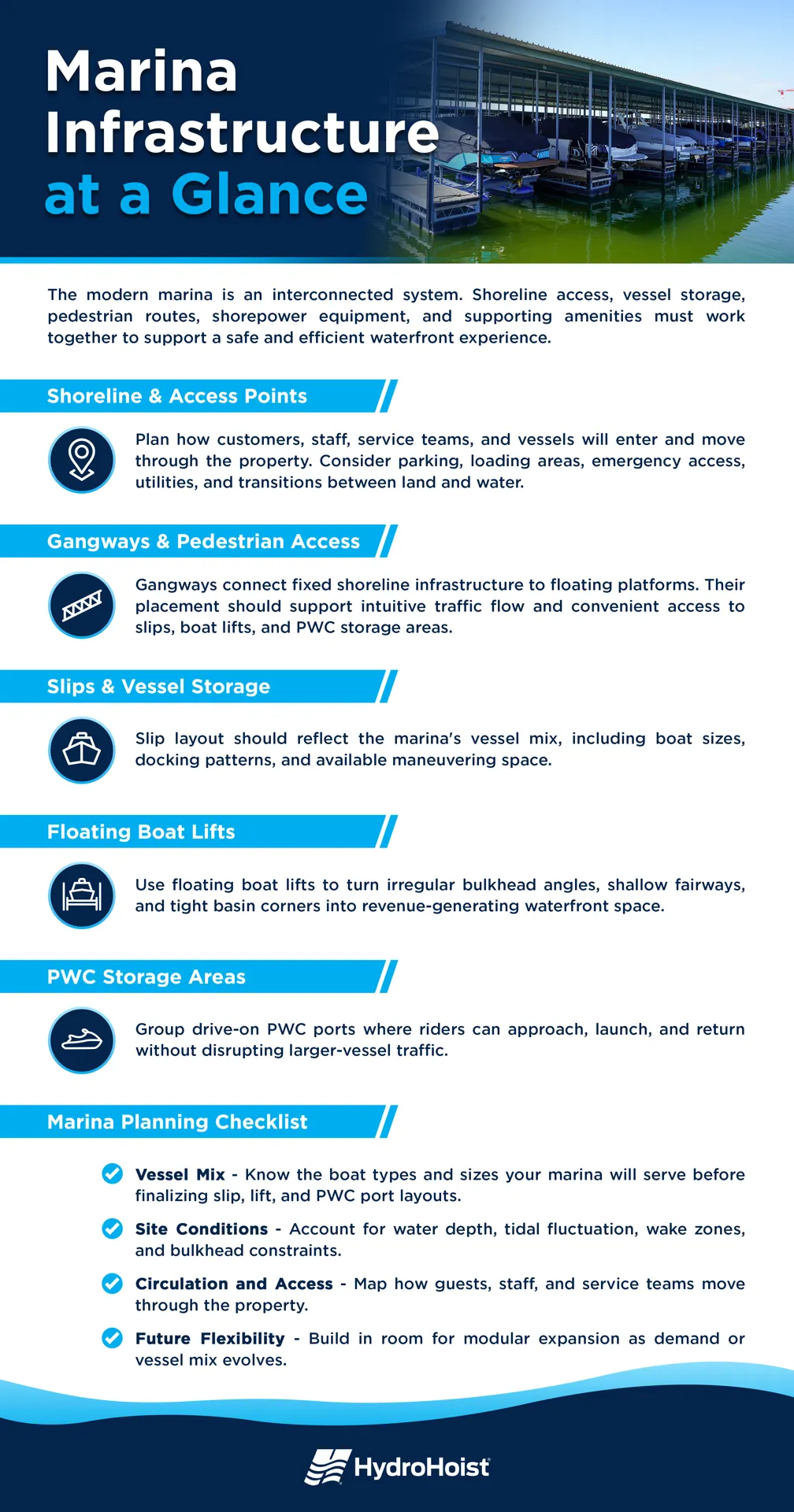
View the Marina Infrastructure Map
Dock Requirements and Layout Considerations
The marina layout is its most significant operational lever. A well-planned dock system features a strategic balance of slip sizes to maximize revenue per linear foot. Decision-makers must analyze local market data to determine what types of vessels the marina should cater to. For example, if 70% of local boats are 30–40 feet, building 60-foot slips will lead to low revenue per foot.
The layout must also ensure that shore power and water hookups can handle the load of the specific slip size (e.g., 50-amp vs. 100-amp) to avoid under-powered slips that cannot be rented at full price. Meanwhile, the distance between docks must be at least 1.5 to 1.75 times the length of the longest boat in that row to ensure safety. Overbuilding fairways wastes rentable water, while underbuilding them creates a liability.
Clear traffic flow is equally critical; fairway widths, turning basins, and approach angles must accommodate peak activity while mitigating congestion or the risk of collisions. A well-planned layout minimizes bottlenecks while making docking intuitive for both experienced captains and transient boaters.
Expansion planning is another critical consideration that often gets overlooked in early design phases. Reserving space for additional slips, utilities, or upgraded lift capacity allows marinas to scale alongside demand without disrupting operations. This forward-thinking approach also supports phased development, helping owners manage capital investment while maintaining service continuity.
Lift Solutions for Modern Marinas
At HydroHoist, we understand that every marina is different, with unique layouts, slip sizes, and customer preferences. That’s why we offer a range of boat lift marina models, sizes, and configurations to accommodate virtually any boat type and installation requirements. With capacities ranging from 4,400 to 32,000 lbs. and adjustable bunks and supports, HydroHoist boat lifts ensure your customers get the best protection and storage solution for their vessels.
UltraLift Series
With capacities ranging from 5,000 to 9,000 lbs and customizable bunks, hull supports, flotation tank configurations, and mounting options, the UltraLift Series boat lift models are some of the most popular in HydroHoist’s line. Built to last and perform in challenging waterfront conditions, they feature rugged, custom-molded polyethylene tanks, heavy-duty torsion bars, and a smart design that keeps all steel parts above the waterline.
Combine that with push-button operation and one of the fastest lifting and lowering cycles in the industry, and you have a convenient and reliable solution for storing and protecting vessels. Whether you’re looking for front-mounted boat lifts or a flexible system to outfit your marina with, authorized HydroHoist dealers can tailor an UltraLift configuration to suit your unique requirements.
HarborHoist
Experience unmatched convenience, versatility, and performance with the HarborHoist H2 – HydroHoist’s innovative drive-on, free-floating boat lift. With capacities ranging from 4,400 to 25,000 lbs, customizable float configurations, hull supports, anchoring, and mooring options, and the ability to operate in waters as shallow as 48”, the HarborHoist offers a highly adaptable in-water storage solution and protection for a diverse range of vessels in fresh, brackish, and saltwater environments.
Authorized HydroHoist dealers and installers can work with you to design the optimal boat lift system for your marina’s unique environmental and installation challenges. Whether you require a heavy-duty saltwater lift with reinforced supports or a low-profile, shallow-water hoist, we can customize a solution to enhance your marina’s customer experience.
HyPower Electrical Planning and Utility Integration
Electrical planning is considered one of the most consequential decisions in marina design because it dictates how power is generated, distributed, and scaled across the entire facility. Pushing electrical planning down the priority list often results in constrained layouts, undersized capacity, or costly redesigns when boaters’ power demands exceed initial assumptions.
HyPower’s TotalPower Solutions are built to streamline this process by delivering a fully integrated approach to marina electrical infrastructure. This service includes integrated electrical design to optimize layout and load distribution and the necessary electrical components, such as substations, panelboards, transformers, wiring, and cabling–all from a single source.
The service pairs HyPower marina power pedestals with heavy-duty distribution equipment:
Primary Distribution: Includes substations, transformers, panelboards, and switchgear required to manage large-scale power loads.
Secondary Distribution: Provides the specific wire and cabling required for your project’s layout and load distribution.
Power Pedestals: Features the PowerPort (400-amp capacity) and EnergyMate (120-amp capacity) units.
This comprehensive electrical ecosystem ensures that load distribution, system layout, and equipment selection are all engineered to work together—reducing friction during installation and improving reliability once the marina is operational. Contact HyPower at (800) 825-3379 to learn more.
ADA, Safety, and Compliance Basics
In the U.S., public docks and private facilities used for commercial, municipal, or recreational purposes must comply with the Americans with Disabilities Act Accessibility Guidelines (ADAAG). This includes providing safe, navigable access routes, proper slopes, stable surfaces, and accessible transfer systems for boarding watercraft. Non-compliance can lead to legal issues, funding barriers, and fines (U.S. Access Board, n.d.).
ADA-compliant design considerations influence dock heights, gangway slopes, handrail placement, and access routes, ensuring that individuals with mobility challenges can safely navigate the facility. When these elements are integrated early (rather than retrofitted later), marinas can offer a more inclusive experience without compromising layout efficiency or aesthetics.
Compliance-driven planning also plays a critical role in risk management. Standards such as NFPA 303 and the National Electrical Code guide everything from fuel dock safety and fire protection access to proper grounding and electrical system design. Aligning infrastructure with these frameworks reduces the likelihood of accidents, operational disruptions, and liability exposure, while also simplifying inspections and approvals throughout the project lifecycle.
Ultimately, safety and compliance are enablers of long-term performance and trust. Facilities that prioritize accessibility, adhere to established codes, and proactively address risk are better positioned to attract users, maintain operational continuity, and adapt to evolving regulatory expectations over time.
Building a Future-Ready Marina
The modern marina is continually evolving. Once a place to store and service boats, they’re increasingly becoming destinations in their own right, offering a range of resort-like amenities and services to attract and retain more customers. From upscale dining and entertainment to concierge services and state-of-the-art facilities, marinas are always looking for new ways to provide the ultimate boating experience.
In this competitive landscape, agility enables long-term adaptability. Marinas designed with scalable infrastructure, efficient layouts, and integrated systems are better positioned to stay competitive as the industry evolves. Modular dock systems, upgradable electrical pedestals, and phased expansion plans allow marina owners to respond to shifting customer needs without disrupting daily operations.
Ultimately, building a future-ready marina comes down to alignment—between infrastructure and demand, design and compliance, and short-term goals and long-term vision. When these elements are thoughtfully integrated from the start, marina owners can deliver a more resilient, efficient, and high-performing waterfront environment that continues to meet user needs well into the future.
Request a Marina Infrastructure Consultation
FAQs
What infrastructure does a marina need?
A marina requires a coordinated mix of docks, boat lifts, electrical systems, water supply, fueling stations, high-speed internet connectivity, access points, and other amenities that enhance customer experience. These elements must be designed to work together, ensuring efficient vessel movement, reliable utilities, and a safe environment for both operators and boaters.
Are boat lifts a good fit for marinas?
Absolutely. From a commercial perspective, lift-equipped slips typically command 20% to 40% higher rental premiums than standard wet slips, often paying for themselves within three years.
They help minimize hull fouling, corrosion, and maintenance needs while improving turnaround efficiency for high-traffic facilities, making them invaluable investments for boosting ROI and customer retention.
What should marina owners consider when planning electrical access?
Owners must plan for both current load and future scalability by integrating electrical design into the earliest stages of site planning. Key considerations include the placement of substations to prevent voltage drops, the installation of modular pedestals that enable easy upgrades to higher amperages, and strict adherence to NFPA 303 and NEC standards to ensure safety and insurability.
How do ADA requirements affect marina design?
ADA compliance is a critical legal and ethical component of marina planning that influences the slope of gangways, the width of finger piers, and the accessibility of utility pedestals. Designing with accessibility in mind not only reduces legal liability but also broadens your market appeal, ensuring that your facility is inclusive and navigable for boaters of all mobility levels.
References:
Dan Williams & Marcus Rue, MSA Professional Services (August 14, 2025). Understanding the Marina Permitting Process, https://www.msa-ps.com/understanding-the-marina-permitting-process/
U.S. Access Board (n.d.). Guide to the ADA Accessibility Standards, https://www.access-board.gov/ada/guides/chapter-10-boating-facilities/


