Key Takeaways
There is no universal "best" boat lift.
Floating and vertical lifts solve different waterfront challenges.
Water depth, shoreline conditions, and dock layout matter more than product popularity.
Dealer guidance helps ensure the right long-term investment.
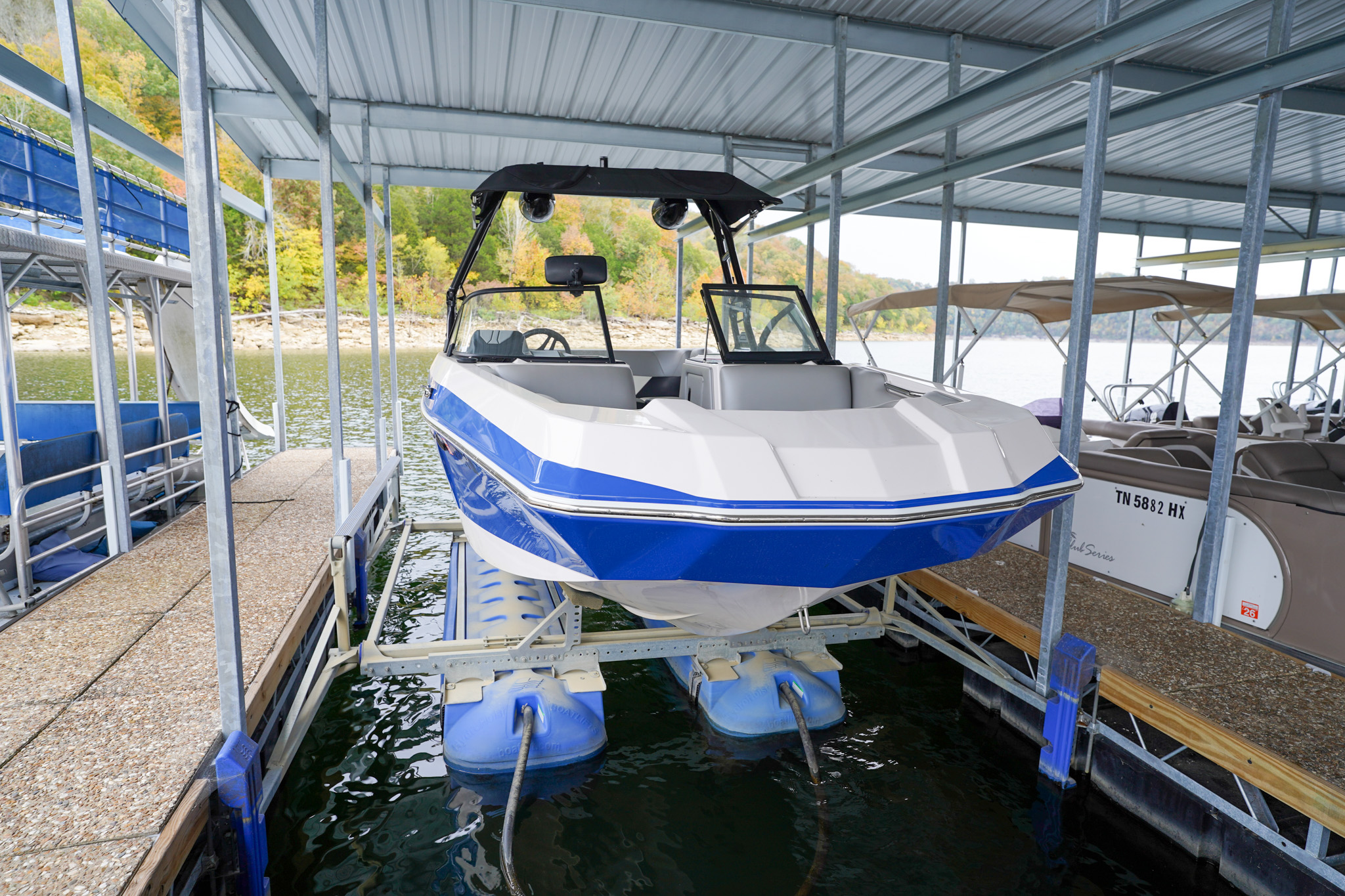
Understanding the Difference Between Floating and Vertical Boat Lifts
A floating boat lift utilizes air and water displacement in its flotation tanks to control buoyancy. To lift the vessel, an electric blower system pumps air into the tanks, forcing water out to raise the boat above the waterline.
To launch the vessel, air is released from the tanks through the control system valves. This fills the tanks with water, causing the lift platform to submerge below the waterline so the boat can float free.
Meanwhile, a vertical boat lift uses a system of cables, pulleys, and electric or manual winches to lift vessels out of the water. Because the lift structure is fixed to the lakebed, dock, or pilings, the available lifting travel depends on the system’s design and the site’s water depth.
Check out our blog to learn more about how boat lifts work.
When Floating Boat Lifts Perform Best
Floating boat lifts excel on waterfronts that experience fluctuating water levels. Because the system floats in tandem with docks, floating boat lifts eliminate the need to manually adjust legs, cables, or mounting hardware as water levels rise and fall. As such, they’re widely recognized as the best boat lift for fluctuating water caused by seasonal drawdowns, heavy rain, or tidal movement.
Floating systems are also the preferred choice for deep-water locations where installing or operating traditional vertical lifts is either impractical or physically impossible. Because they don’t rely on pilings or a firm lakebed for support, floating boat lifts are ideal in-water storage solutions for sites with rocky bottoms, thick mud, or depths that exceed the reach of vertical lift legs.
Many modern marinas favor floating lifts for the same reasons—they bolt seamlessly to floating dock networks, require no disruptive piling work, and meet environmental regulations that prohibit bottom‑standing structures.
When Vertical Boat Lifts May Be the Better Choice
Vertical lifts provide a practical, proven solution that has served recreational boaters for decades. They perform best in shallower lakes with firm, level lakebeds and water levels that stay relatively consistent throughout the boating season.
Floating boats primarily work with floating docks. If you already have a fixed or standing dock, a vertical lift can be integrated into your existing dock footprint or mounted directly to your pilings, making it a cost-effective and seamless addition for many traditional dock setups.
For property owners in calm, shallow coves with minimal water fluctuations and light-to-midsize boats, a vertical lift provides a proven, straightforward solution for securely raising vessels out of the water.
Comparing Maintenance and Ownership
While both floating and vertical boat lifts are designed to protect your vessel, the day‑to‑day ownership experience differs in terms of accessibility, routine maintenance requirements, and potential seasonal considerations.
Accessibility: Floating lifts rise and fall with the waterline, keeping the boat consistently aligned with the dock regardless of water level fluctuations. Vertical lifts, by contrast, may require manual adjustments to legs or cables if water levels shift outside their travel range.
Routine Maintenance: Floating systems require periodic checks of air hoses for leaks and keeping flotation tanks clear of heavy marine growth to maintain optimal buoyancy. Vertical lift maintenance primarily focuses on regular cable inspections, winch lubrication, and ensuring the structural frame remains level on the lakebed.
Seasonal Considerations: Seasonal maintenance depends largely on local climate and waterfront conditions. In regions with freezing winters, owners should follow manufacturer recommendations for winterizing, while year-round boating areas may focus more on periodic inspections and preventive maintenance.
Over the life of the lift, maintenance needs are influenced by factors such as water conditions, usage frequency, environmental exposure, and adherence to routine service schedules. Regardless of lift type, working with an experienced dealer for periodic servicing and ongoing support can help maximize performance and longevity.
Floating Boat Lift | Vertical Boat Lift | |
Water Depth | Ideal for deep water and fluctuating conditions | Well-suited for shallow to moderate, consistent depths |
Maintenance | Leak inspections and keeping flotation tanks clear of heavy marine growth | Requires regular lubrication and cable, winch, and pulley inspections |
Dock Compatibility | Ideal for floating docks | Ideal for fixed/standing docks and level lakebeds |
Installation | Attaches directly to the dock structure | Rests on the lakebed or mounts to structural pilings |
Ideal Applications | Reservoirs, deep lakes, tidal zones, marinas | Shallow lakes, stable water levels, static piers |
For more information, check out our Boat Lift Buying Guide.
Five Questions to Ask Before Choosing a Lift
How much does my water level change?
If your waterfront experiences seasonal drawdowns, tides, or heavy rainfall, a floating lift may be a better fit, as it adjusts automatically with the waterline. Vertical lifts, on the other hand, work best in stable conditions where depth remains consistent.
What type of dock do I have?
Floating lifts bolt directly to floating dock networks, while vertical lifts require pilings or a firm lakebed for support. Knowing your dock type ensures you choose a lift that integrates seamlessly without costly modifications.
What size boat do I own?
Standard vertical lifts are highly efficient for small to midsize boats, but generally max out around 10,000 to 20,000 lbs. Reaching higher capacities requires massive, expensive steel beams and heavy-duty dual-motor winch systems that can overwhelm traditional pilings.
Floating lifts handle massive vessels much more easily. Manufacturers simply increase the length or diameter of polyethylene tanks to achieve significant buoyancy. This allows them to lift large cruisers, yachts, and multi-engine performance boats weighing up to 32,000+ lbs.
How often do I use my boat?
High-frequency use means the cables on a vertical lift are constantly winding and unwinding, rubbing against pulleys under thousands of pounds of tension. Frequent boaters will wear out vertical lift cables much more quickly, requiring strict inspection schedules and frequent replacements to prevent catastrophic failure.
Floating lifts are better suited for high-frequency cycling. The only moving parts under stress during lifting and launching are the heavy-duty rubber pivot bushings and the air blower motor, both of which are often designed for high-repetition commercial marina use.
Am I planning for future upgrades?
If you buy a lift for a 20-foot bowrider today but want to upgrade to a wider 24-foot wakeboard boat or a wide-beam pontoon in five years, the new boat may not physically fit between the vertical posts.
Because floating lifts sit underneath the hull rather than framing it, width constraints are rarely an issue. And if you upgrade to a much heavier boat in the future, many premium floating lift brands allow you to add flotation tanks or upgrade the tank size to increase the lift's weight capacity without replacing the entire system.
Not sure which lift style fits your waterfront?
How HydroHoist Helps Match the Right Lift to Your Waterfront
Every waterfront can present unique challenges. That’s why we recommend working closely with authorized dealers early in the buying process. In addition to their intimate knowledge of local environmental conditions, they can conduct a site assessment to determine the optimal boat lift configuration for your shoreline, dock layout, and boat specifications.
Beyond recommending the ideal system, authorized HydroHoist dealers are trained to be waterfront partners, providing ongoing service and long-term ownership support to help keep your lift performing at its best.
If another solution better suits your needs, they can also recommend products from sister brands within the growing Waterfront Brands group, giving you seamless access to some of the most trusted brands in the industry.
Choosing the Right Lift Starts with Understanding Your Waterfront
Choosing between a floating boat lift and a vertical boat lift isn't about finding a universally "better" option—it's about finding the right solution for your waterfront. By evaluating your shoreline conditions and dock configuration, you can choose a lift that protects your investment while making every day on the water easier.
Ready to explore some of the best in-water storage solutions on the market? Enter your zip code at the bottom of this page to find an authorized HydroHoist dealer near you.
FAQ
What is the difference between a floating and vertical boat lift?
A floating boat lift utilizes air and water displacement in its flotation tanks to control buoyancy. Meanwhile, vertical boat lift uses a system of cables, pulleys, and electric or manual winches to lift vessels out of the water. Because the lift structure is fixed to the lakebed, dock, or pilings, the available lifting travel depends on the system’s design and the site’s water depth.
The key difference is that floating lifts naturally adapt to changing water levels. This allows the system to remain usable even during seasonal drawdowns or significant tidal movement.
Which boat lift is better for fluctuating water levels?
A floating boat lift is significantly better for areas that experience water level fluctuations because it naturally rises and falls with the waterline. Vertical lifts, in contrast, stand on the lakebed, which can limit their lifting range and render them unusable if water levels drop or rise drastically.
Are floating boat lifts easier to maintain?
Yes, floating boat lifts are generally easier to maintain because they eliminate high-stress cables and pulleys that tend to fray, rust, and flatten. However, they do require periodic scraping to clear heavy marine growth from the tanks and basic monitoring of the blowers and air hoses.
Which lift is better for larger boats?
Floating lifts are generally recommended for larger boats because their capacity can be easily scaled up by adding flotation tanks to handle heavy yachts or cruisers weighing up to 32,000+ pounds. Standard vertical lifts face structural limitations at higher weights, requiring massive, expensive steel beams and dual-motor winches that put heavy stress on docks and pilings.
How do I know which lift is right for my waterfront?
The right choice depends on your specific water depth, dock configuration, and local water fluctuations. A vertical lift is best for shallow water over a firm lakebed with stable water levels, while a floating lift is the ideal choice for fluctuating, deep, or tidal environments.
We recommend consulting an authorized dealer to determine the optimal solution for your unique needs.


