Key Takeaways
Heavy-duty lifts need customized slip, depth, and power planning.
Slip width and truss design affect installation feasibility.
Water depth and torque capacity determine performance and safety.
Verify marina infrastructure before purchase to avoid costly adjustments.
HydroHoist heavy-duty lifts are engineered for vessels up to 32,000 lbs.
What Defines a Heavy-Duty Boat Lift
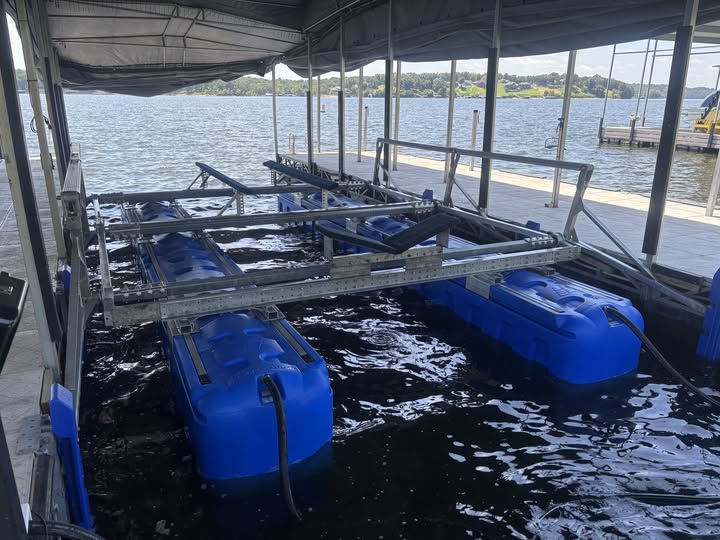
A boat lift is classified as heavy-duty when it is engineered to support vessels weighing 10,000 lbs to 30,000+ lbs, such as large center consoles, cabin cruisers, and triple-tube pontoons. Because of the torque and lifting force required to raise heavier vessels, these lifts often move away from winch systems in favor of sealed hydraulic cylinders or hydropneumatic tanks.
These advanced lifting mechanisms deliver smooth, consistent performance—an essential factor for heavier vessels, where uneven rise or sudden load shifts can introduce stress to the hull, stringers, and lift frame itself. At this scale, even minor imbalances are magnified. A lift that raises unevenly can overload individual bunks or concentrate stress at contact points.
Controlled, synchronized lifting ensures the boat rises as a single unit, maintaining proper hull support from waterline to storage height.
Slip Width, Length, and Clearance Requirements
Slips for heavy-duty boat lifts must be wide enough to accommodate the vessel’s beam (widest point) and the lift infrastructure, including guide posts, bunk extensions, and cradle assemblies. For reference, the 10,000-lb HydroHoist UltraLift requires a minimum slip width of 10 feet. This goes up to 12 feet for 16,000 and 18,000-lb UltraLift models, and 16 feet for 24,000 and 28,000-lb models.
Meanwhile, slips for high-capacity boat lifts should be at least 2 to 4 feet longer than the vessel’s overall length, including outboard motors, bow spirits, and swim platforms. The slip must be long enough to allow the boat’s center of gravity to align perfectly over the lift’s primary support beams. This ensures balanced weight distribution, which prevents uneven loading and minimizes hull strain (Amon, n.d.).
When dealing with the massive forces required to lift heavy vessels, clearance equals safety. Even minor interference during the lift cycle, such as a cradle beam brushing a piling or a bunk clipping dock hardware, can cause structural damage, bent cylinders, or costly vessel repairs.
Before installing heavy-duty boat lifts, we always recommend coordinating with marina personnel to identify underwater trusses, cross-bracing, and other submerged structures that could interfere with the lift’s operation. Authorized HydroHoist dealers are experienced in coordinating with marina operators to verify clearances and ensure the lift configuration aligns with existing infrastructure.
Depth and Configuration Requirements
While lower-capacity lifts often operate in 4 to 5 feet of water, lifts rated for heavier vessels typically require 6 to 7 feet or more to function safely and efficiently. For reference, a 20,000-lb boat lift from HydroHoist requires a minimum depth of 7 feet (plus draft). Heavier boats sit deeper in the water and require additional depth to float on and off the bunks without excessive lift angles or hull contact.
Certain configurations demand even greater depth. Back-in lifts, commonly used in tight marinas or where bow access is limited, require longer lifting arms to reach beneath the vessel’s center of gravity. These longer arms change the lift geometry and increase the vertical travel needed, often pushing minimum depth requirements beyond those of a traditional front-entry lift.
Back-in configurations place the heaviest part of the vessel, the engine, further out on the lift’s structure, requiring precise weight distribution. Without adequate depth, the lift cradle may strike the ground before reaching its full range of motion, preventing the boat from floating freely and potentially straining the lifting mechanisms.
Power and Control System Needs
Heavy-duty lifts often require higher amperage, specific voltage configurations, and dedicated control panels to safely operate hydraulic or hydropneumatic systems. Before installing a high-capacity lift, we recommend having a licensed electrician verify that the power supply can handle the startup load without a significant voltage drop, which can damage motors over time.
High-capacity lifts also rely on synchronized flow control to keep the cradle perfectly level as it rises. If the power supply is inconsistent or the control panel is improperly matched to the pump's requirements, the lift may experience "shuddering" or uneven lifting. This is especially dangerous for large-vessel lifts where even a slight tilt can shift the boat’s center of gravity.
Before finalizing your purchase, confirm the outlet type and breaker capacity of your slip. Working with your marina and an authorized dealer early ensures your electrical infrastructure is ready to support the sophisticated control systems required for a heavy-duty boat lift.
Marina Infrastructure and Installation Considerations
One often-overlooked factor when installing high-capacity boat hoists is how lift loads are transferred through the marina system. While flotation-assisted lifts reduce concentrated pressure on the lake or seabed, installation still requires sufficient clearance around pilings, walkways, and dock framing to accommodate lift movement, service access, and seasonal water changes (Pile Buck, 2026).
Gangways, finger piers, and floating dock connections must allow for vertical travel without binding or transferring unintended forces into the dock structure. Submerged utilities and anchoring systems are another common blind spot. Electrical conduits, water lines, sewer laterals, mooring anchors, and cable systems may run beneath the slip and are not always documented in marina plans.
Interference with these components can limit lift placement or require reconfiguration. This is especially important in older marinas or mixed freshwater–saltwater environments where infrastructure has been modified over time.
Environmental Factors
Environmental conditions, including wave action, boat traffic, prevailing winds, and seasonal water fluctuations, all affect how a heavy vessel behaves while lifting and while stored. A lift that performs well in calm inland water may require additional stabilization or spacing in a high-traffic marina or coastal basin. Ice, debris, and sediment movement should also be considered in regions with freeze–thaw cycles or shifting bottoms.
Because these factors vary widely by location, close coordination is essential. Buyers should always work directly with the marina before finalizing the purchase. At HydroHoist, our authorized dealers are experienced in evaluating site conditions, coordinating with marina engineers and managers, and ensuring the selected lift configuration aligns with structural, electrical, and environmental constraints.
This upfront planning helps prevent costly modifications, delays, or safety issues after the lift is installed. To learn more about the optimal boat lift weight capacity for your vessel, enter your zip code in the dealer locator tool below. This will give you a list of authorized HydroHoist partners, along with their contact information and driving directions.
FAQs
What boat size needs a 20,000 lb lift?
Lifts in this class are typically required for large center consoles (30–40 feet), cabin cruisers, and high-performance triple-tube pontoons. It is essential to calculate your vessel’s "wet weight," which includes a full tank of fuel, water, engines, and all gear, as these can easily add 2,000–4,000 lbs to the manufacturer’s base dry weight.
How deep should the water be for a heavy-duty lift?
Generally, you should have a minimum water depth equal to your boat's draft plus an additional 12 to 24 inches for the lift cradle clearance. For many heavy-duty vessels, this results in a functional requirement of at least 7 feet of water to ensure the boat can float on and off the bunks without hitting the ground.
What power requirements are needed?
Most 20,000+ lb lifts require a dedicated 220V electrical circuit with a 30-amp breaker to power the high-capacity hydraulic or hydropneumatic pumps. Using standard 110V household outlets often results in significant voltage drops, which can cause motors to overheat or the lift to operate unevenly under heavy loads.
Can I retrofit a marina slip for a 20k+ lift?
Yes, but it requires a thorough structural audit of the existing slip's width and piling stability. You may need to relocate underwater cross-bracing or upgrade the dock’s electrical service to ensure the infrastructure can handle the massive physical and electrical demands of a high-capacity system.
Are custom heavy-lift systems available?
Yes. HydroHoist offers customizable configurations for vessels that exceed standard dimensions or weigh up to 32,000 lbs. These can include specialized bunk arrangements for unique hull shapes and reinforced frame designs to accommodate extra-wide beams or specific weight distributions.
References:
Meredith Folger Amon (n.d.). Determining The Right Boat Lift and Slip Size for Your Coastal Property, https://www.searchthegulf.com/blog/boat-lift-and-slip-sizing-guide/
Pile Buck (January 29, 2026). Floating Docks vs. Fixed Piers: Foundation Considerations in Marina Design, https://pilebuck.com/floating-docks-vs-fixed-piers/


